Construction and renovation projects in occupied or protected buildings create a common and costly problem: false fire alarms triggered by dust, debris, and airborne particulates activating smoke detectors. The solution is simple — smoke detector dust covers — but many contractors and facilities managers underestimate when and how to use them properly. This guide covers why dust covers are required, which covers to use, and how to manage them throughout a construction project.
Why Construction Activities Trigger Smoke Alarms
Photoelectric and ionization smoke detectors are exquisitely sensitive to airborne particles. That sensitivity is exactly what makes them effective at detecting fires — but it also makes them prone to false alarms when drywall dust, sawdust, spray texture, joint compound mist, or demolition debris enters the detector chamber.
A false alarm during a construction project causes multiple problems:
- Disruption: Workers must stop and evacuate; the building must be cleared and searched
- Emergency response costs: False alarms can trigger automatic fire department dispatch, resulting in fees in many jurisdictions
- Contractor liability: Repeated false alarms can result in monitoring center charges, inspection fees, and contract penalties
- Detector damage: Heavy contamination can permanently damage sensitive detector components, requiring replacement
NFPA Requirements for Detector Protection During Construction
NFPA 72 — National Fire Alarm and Signaling Code — addresses the use of smoke detectors in areas under construction. Section 10.18 permits smoke detectors to be placed out of service during construction activities if specific conditions are met, including prior notification to the AHJ and monitoring organization, and implementation of an impairment management plan.
Critically, NFPA 72 also requires that detectors be protected from contamination during construction. The standard approach accepted by most AHJs is to cover detectors with listed or approved covers during active construction work — and remove them immediately when work stops or at the end of each work shift.
The key compliance requirements are:
- Covers must be removed when work stops — detectors must be operational during non-work hours
- Covers must be compatible with the detector (correct size and airflow properties)
- A responsible party must be designated to manage cover installation and removal
- The impairment must be tracked and documented
The SMDC-1 Smoke Detector Dust Cover
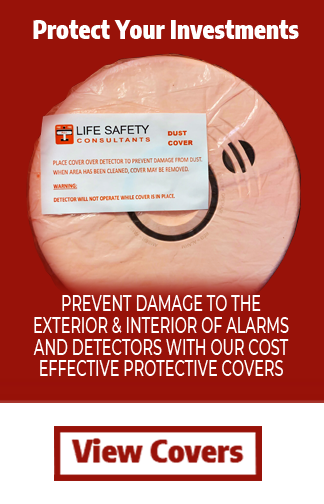
The SMDC-1 is the industry-standard smoke detector dust cover for commercial construction applications. It is an elastic-top, polypropylene cover that fits over standard ceiling-mounted smoke detectors, preventing dust and debris from entering the detection chamber while still allowing the detector to remain electrically active (for supervision purposes).
The SMDC-1 smoke detector dust cover is available from Life Safety Consultants in packages of 25 — practical for project-scale deployment. With over 1,800 units sold, it’s one of the most popular items we carry.
Key features:
- Bright yellow color for easy visual identification during inspections
- Elastic band secures cover to detector base without adhesives
- Compatible with most standard 4-inch and 6-inch ceiling-mount detectors
- Reusable (clean after use for multi-project deployment)
- Disposable version available for single-use applications
Heat Detector Covers
While smoke detectors get most of the attention during construction, heat detectors can also be contaminated or damaged by construction debris. Dedicated heat detector covers are also available for projects where both detector types are present. If your system includes combination detector/notification appliances, covers should be coordinated with your fire alarm contractor to ensure all protected devices are covered appropriately.
How to Remove and Reinstall Dust Covers
Proper management of dust covers is as important as using them in the first place:
- Before work: Cover detectors in the immediate work area and adjacent areas where dust migration is likely
- During work: Inspect covers periodically — a cover that has been knocked loose isn’t protecting anything
- End of shift: Remove ALL covers before leaving. Covered detectors cannot detect fire
- After final cleanup: Inspect detector chambers for contamination before returning system to full service. If detectors appear contaminated, test them before clearing the impairment
- Final inspection: Walk the work area with a detector test instrument or smoke aerosol to verify all uncovered detectors are functional
Ordering Dust Covers for Your Project
Order early — dust covers should be on-site before demolition or drywall work begins. For large projects, estimate one cover per detector in and near the active work zone, plus a 10–15% overage for lost or damaged covers.
Browse our full selection of fire alarm accessories at Life Safety Consultants, or go directly to the SMDC-1 smoke detector dust cover product page to order in bulk for your next project.