NFPA 72 requires that commercial smoke detectors be tested for sensitivity on a scheduled basis — within the first year of installation and every other year thereafter. Yet sensitivity testing is one of the most frequently skipped or superficially performed elements of a fire alarm inspection. For fire alarm technicians, understanding the testing process, what sensitivity drift means, and when cleaning versus replacement is the appropriate response is essential both for code compliance and for delivering genuine value to building owners.
Why Sensitivity Testing Matters
Smoke detectors have an acceptable sensitivity range established by UL 268 and referenced in NFPA 72. For most photoelectric detectors, the listed sensitivity range is expressed in percent obscuration per foot — typically 0.5% to 4.0%/ft for photoelectric units, though the specific range varies by model and listing. A detector that has drifted outside this range is either too sensitive (prone to nuisance alarms) or not sensitive enough (may fail to detect a real fire promptly). Both conditions are safety concerns and code violations.
On conventional systems, sensitivity drift is invisible until the detector either false-alarms or fails to alarm. On addressable analog systems — which represent the majority of commercial installations today — the panel continuously monitors each detector’s analog value, providing early warning of drift before it becomes a compliance failure.
Field Testing Methods
There are two primary methods for conducting sensitivity testing on commercial smoke detectors:
Panel-Based Sensitivity Reporting (Addressable Systems) — On addressable analog systems, the control panel can report the current sensitivity reading for each detector. Most addressable panels (Notifier, Simplex, Edwards EST, Siemens) allow technicians to access sensitivity readings from the panel keypad or through connected laptop software. If the reading falls outside the detector’s listed acceptable range, the detector requires cleaning or replacement.
This is the most efficient method for large buildings — a technician can walk through the detector list on the panel software and identify every out-of-range detector in minutes, then focus physical attention only on those units. The Notifier FSP-851 and similar intelligent detectors provide exactly this type of panel-readable sensitivity data.
Field Sensitivity Testers — For conventional systems, or as a verification method for addressable systems, handheld smoke detector test equipment (such as the Testifire or SDi Solo units) can deliver controlled smoke aerosol concentrations to test sensitivity more precisely. These tools allow technicians to apply a calibrated smoke concentration and verify that the detector activates within its listed sensitivity range.
Laboratory Testing — NFPA 72 permits sending detectors to an approved third-party laboratory for sensitivity testing. This is less common in practice but may be specified by some AHJs or for specific high-stakes applications.
What Is Sensitivity Drift?
Sensitivity drift occurs when contamination accumulates inside the detector’s sensing chamber, altering the optical or electrical characteristics that the detector uses to sense smoke. Common sources of contamination include:
- Dust and construction debris
- Insect intrusion (a surprisingly common cause of nuisance alarms)
- Cooking grease or residue in or near food service areas
- Tobacco smoke residue in older buildings
- Corrosive vapors in industrial or laboratory environments
As contamination accumulates, a photoelectric detector typically drifts toward higher sensitivity (the light scatter increases because particles are already present in the chamber), increasing false alarm risk. Over time, the chamber may become so contaminated that it can no longer accurately detect actual smoke.
When to Clean vs. When to Replace
Cleaning is appropriate when:
- The detector is within its service life (typically less than 8-10 years from manufacture)
- Contamination is mild and the sensitivity drift is within a recoverable range
- The panel indicates “Maintenance Alert” or early drift rather than “Maintenance Urgent” or full out-of-range status
- Cleaning can be performed with manufacturer-approved methods (compressed air, soft brush) without disassembling sealed sensing chambers
Replacement is required when:
- The detector is at or beyond the 10-year replacement interval (NFPA 72)
- Cleaning fails to restore sensitivity to within the acceptable range
- The detector has suffered physical damage, water intrusion, or corrosion
- The panel reports persistent “Maintenance Urgent” or replacement-required codes after cleaning
- The detector model is discontinued and repair/recertification is not available
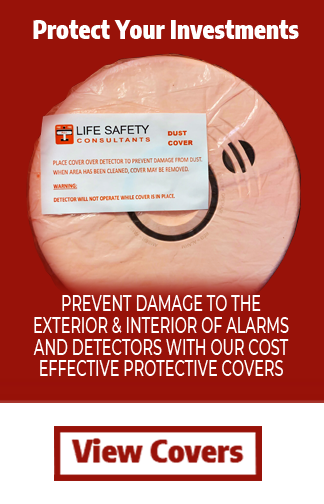
One practical note: using smoke detector dust covers during construction or renovation activities significantly reduces contamination-related drift and extends detector service life. Installing dust covers before any drywall, sanding, or concrete work is a low-cost way to protect a significant investment.
Documentation Requirements
NFPA 72 requires that sensitivity test results be documented and retained as part of the inspection records. The documentation should include the detector address or zone, the test date, the sensitivity reading or pass/fail result, and any corrective action taken (cleaning or replacement). This documentation is subject to AHJ review during inspections and is increasingly important for building owners managing liability exposure.
For buildings with addressable systems, maintaining panel printouts or exported sensitivity reports as part of the inspection file is the most efficient approach. For conventional systems with field-tested detectors, a device-by-device log is required.
Practical Takeaways for Technicians
Sensitivity testing doesn’t have to be time-consuming on modern addressable systems — the panel does the heavy lifting. Build sensitivity report review into your standard inspection process, and carry replacement detectors for the brands you commonly service. Addressing drift proactively during a scheduled inspection is far more efficient than a callback. For Simplex systems, keep Simplex TrueAlarm sensors on hand; for Siemens systems, the Siemens HFP-11 is a common addressable replacement detector.